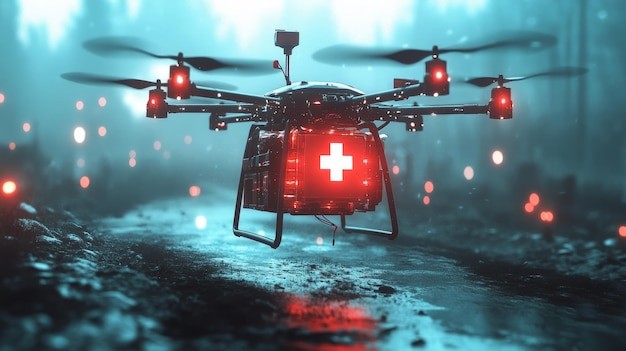
In moments of crisis, every second counts. Whether it’s a raging wildfire, a devastating earthquake, a widespread flood, or a search for a missing person, the ability to rapidly assess a situation, locate victims, and deploy resources effectively can mean the difference between life and death. Traditionally, these critical initial phases of emergency response have relied heavily on human reconnaissance, which can be slow, dangerous, and limited by visibility and accessibility. However, a revolutionary technological convergence is rapidly transforming this landscape: the integration of artificial intelligence (AI) with drone technology, creating AI-powered drones that are proving to be invaluable assets in the high-stakes world of emergency response.
At its core, an AI-powered drone is far more than just a camera in the sky. While conventional drones offer invaluable aerial perspectives, an AI-equipped drone possesses the intelligence to interpret and act upon the data it collects in real-time, often without direct human intervention. This is achieved through advanced machine learning algorithms, computer vision capabilities, and sophisticated sensor fusion. These drones can autonomously navigate complex environments, identify specific objects or anomalies, and even make informed decisions on the fly, significantly enhancing the speed, safety, and efficiency of emergency operations.
One of the most immediate and impactful applications of AI-powered drones is in rapid damage assessment and situational awareness. Following a natural disaster, large areas can become inaccessible to ground teams due to debris, flooding, or damaged infrastructure. Deploying AI drones allows emergency responders to quickly gain a comprehensive aerial overview of the affected zone. Equipped with high-resolution cameras, thermal imaging, and LiDAR sensors, these drones can capture detailed imagery and create 3D maps of the destruction. AI algorithms then analyze this vast amount of data in real-time, automatically identifying damaged buildings, impassable roads, and critical hazards. This provides command centers with an instant, precise understanding of the disaster’s scope, enabling them to prioritize areas for immediate intervention and allocate resources with unprecedented accuracy, far surpassing the speed and detail possible with traditional methods.
In search and rescue (SAR) missions, AI-powered drones are proving to be true lifesavers. Time is always of the essence when searching for missing persons, particularly in challenging environments like dense forests, mountainous terrain, or collapsed structures. Drones equipped with thermal cameras can detect human heat signatures even through thick foliage, smoke, or in complete darkness. The AI component takes this capability a step further by filtering out false positives (like animal heat signatures) and intelligently highlighting potential survivors, reducing the cognitive load on human operators and dramatically speeding up the search process. Some advanced systems can even identify movement patterns or specific colors indicative of a person, allowing rescue teams to pinpoint locations with greater precision, even under debris. This enhanced capability significantly increases the chances of locating individuals during the critical “golden hours” post-disaster, directly contributing to higher survival rates.
Beyond mere observation, AI-powered drones can also facilitate communication and logistics in compromised environments. In disaster-stricken areas, traditional communication networks often collapse, leaving affected populations and even first responders isolated. Drones can be equipped with communication payloads to act as temporary mobile cell towers, restoring connectivity and enabling critical information exchange between ground teams, command centers, and survivors. Furthermore, autonomous AI drones can be programmed to deliver essential supplies – such as medical kits, food, water, or communication devices – to remote or inaccessible locations that are too dangerous or difficult for human teams to reach. Their ability to autonomously plan optimal routes, avoid obstacles, and navigate challenging terrains ensures that aid reaches those most in need, swiftly and safely.
The integration of AI also enhances the predictive capabilities of emergency response. By analyzing historical data, current environmental conditions, and real-time drone telemetry, AI models can predict the likely spread of wildfires, the path of floodwaters, or even the stability of damaged structures. This foresight allows emergency services to take proactive measures, such as issuing timely evacuation orders, pre-positioning resources, or reinforcing vulnerable areas, thereby mitigating potential damage and saving lives before a situation fully escalates. This shift from reactive response to proactive preparedness is a profound advantage offered by AI-driven insights.
However, the deployment of AI-powered drones in emergency response is not without its challenges and ethical considerations. Regulatory frameworks are still catching up with the rapid technological advancements, particularly concerning flight restrictions, airspace management in congested disaster zones, and the autonomous operation of drones. Data privacy is another significant concern; drones collect vast amounts of visual and thermal data, and ensuring this sensitive information is securely handled, used ethically, and protected from misuse is paramount. Accountability in cases of malfunction or erroneous decisions made by autonomous AI systems also needs clear legal and ethical guidelines. Furthermore, the cost of advanced AI-equipped drones and the training required for emergency personnel to effectively operate and interpret their data can be substantial, posing barriers to widespread adoption for some agencies.
Despite these complexities, the trajectory is clear: AI-powered drones are set to become an indispensable component of future emergency response strategies. As AI algorithms become more sophisticated, sensors more precise, and drone hardware more robust and affordable, their capabilities will continue to expand. The synergy between human expertise and AI-driven aerial intelligence promises to create a more resilient, responsive, and ultimately safer world. By augmenting human efforts and providing critical, real-time insights in the face of chaos, AI-powered drones are not merely tools; they are evolving into intelligent partners in the relentless pursuit of saving lives and mitigating the impact of disasters.