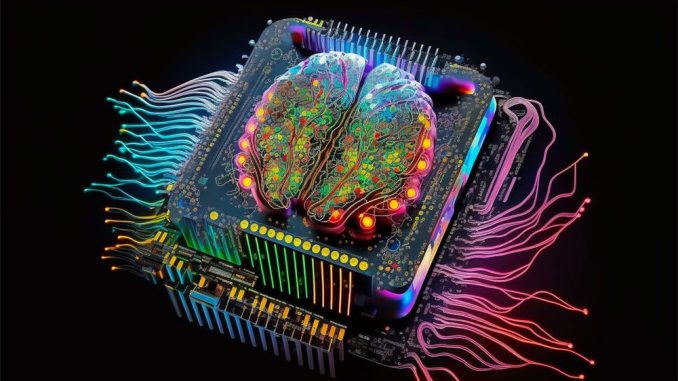
The quest to create truly intelligent machines has been a driving force in technological innovation for decades. While “traditional AI,” predominantly relying on conventional Von Neumann computing architectures and deep learning algorithms, has achieved remarkable feats in areas like image recognition, natural language processing, and strategic gaming, it faces inherent limitations that could be overcome by a radically different approach: **neuromorphic computing**. This emerging paradigm, inspired by the structure and function of the human brain, holds the promise of developing AI systems that are not only more powerful but also dramatically more energy-efficient and capable of real-time, adaptive learning in ways that traditional AI struggles to match.
At the heart of the distinction between traditional AI and neuromorphic computing lies the fundamental architectural difference. Traditional AI systems, running on conventional computers, adhere to the Von Neumann architecture, where the central processing unit (CPU) is physically separate from the memory. This necessitates constant data transfer between the two, leading to the “Von Neumann bottleneck” – a bottleneck that consumes significant energy and limits processing speed, especially for the massive datasets required by modern deep learning models. These systems are also typically synchronous, performing calculations in step-by-step, clock-driven operations, regardless of whether a computation is truly needed.
Neuromorphic computing, conversely, seeks to emulate the brain’s highly parallel, event-driven architecture. Instead of separate processing and memory units, neuromorphic chips integrate “neurons” and “synapses” directly onto the same silicon. These artificial neurons process information by “spiking” (firing) only when a certain threshold of input is reached, much like biological neurons. The strength of the connections (synapses) between these neurons can be modified over time, mimicking the brain’s ability to learn and adapt through synaptic plasticity. This “in-memory computing” approach drastically reduces the need for data movement, thereby slashing power consumption and latency. For instance, while a typical CPU might consume hundreds of watts, a neuromorphic chip like Intel’s Loihi can operate at milliwatt levels, orders of magnitude more efficient for certain AI tasks.
This radical efficiency is one of the most compelling reasons why neuromorphic computing could ultimately surpass traditional AI in specific, yet critical, applications. The human brain, a marvel of biological computing, performs incredibly complex tasks like vision, speech recognition, and decision-making on roughly 20 watts of power. Traditional AI, while powerful, requires enormous data centers consuming megawatts of electricity to achieve similar, albeit often more narrowly defined, feats. As AI continues to proliferate, particularly in edge devices like autonomous vehicles, drones, IoT sensors, and wearable technology, energy efficiency becomes paramount. Neuromorphic chips, with their ultra-low power consumption and ability to process data locally at the source, are ideally suited for these resource-constrained environments, enabling real-time intelligence without draining batteries or relying on constant cloud connectivity.
Beyond energy savings, neuromorphic systems offer significant advantages in **real-time processing and adaptability**. Traditional AI models often require extensive offline training on massive, labeled datasets. Once trained, they can be deployed for inference, but adapting to new, unseen data or continuously learning in dynamic environments requires significant re-training, which is slow and resource-intensive. Neuromorphic systems, with their brain-inspired learning rules like Spike-Timing-Dependent Plasticity (STDP), can learn and adapt continuously and in real-time, directly on the chip. This “on-the-fly” learning capability is transformative for applications demanding immediate decision-making and continuous adaptation, such as autonomous systems navigating unpredictable environments or robots interacting dynamically with humans. Imagine a self-driving car that can learn to interpret an unusual road hazard in milliseconds, rather than needing to be retrained with new datasets.
Furthermore, neuromorphic computing excels at **pattern recognition and anomaly detection**, especially with sparse, noisy, or incomplete data – areas where traditional AI often struggles without extensive preprocessing. The brain’s inherent ability to find patterns and make inferences from ambiguous information is a key inspiration here. Neuromorphic chips are designed to process event-driven data, making them highly effective for sensor-based applications where information arrives asynchronously, such as in audio processing, olfactory sensing, or tactile recognition. This makes them ideal for tasks like identifying subtle anomalies in medical scans, detecting fraud in real-time transaction streams, or recognizing complex patterns in noisy environmental data.
Despite its immense promise, neuromorphic computing is still in its relatively early stages of development and faces considerable challenges. The lack of standardized programming models and mature software tools compared to the well-established ecosystem for traditional deep learning presents a steep learning curve for developers. Designing and manufacturing these brain-inspired chips is also complex, and scaling them to the complexity of the human brain (with its billions of neurons and trillions of synapses) remains a formidable engineering hurdle. However, significant investments from tech giants like IBM (with TrueNorth and NorthPole) and Intel (with Loihi), alongside extensive academic research, are rapidly pushing the boundaries of what’s possible. Projects in Germany, including research at Forschungszentrum Jülich and within the European Union’s Human Brain Project, have been instrumental in developing large-scale neuromorphic machines like SpiNNaker and BrainScaleS.
In conclusion, while traditional AI continues its rapid evolution, neuromorphic computing offers a compelling alternative paradigm that could redefine the future of intelligent systems. By mimicking the brain’s unparalleled efficiency, real-time adaptability, and robust pattern recognition capabilities, neuromorphic chips have the potential to deliver breakthroughs in energy-constrained edge AI, autonomous systems, and advanced sensory processing. As researchers overcome the current engineering and software challenges, the ability of neuromorphic computing to unlock a new generation of AI, one that is truly intelligent, adaptive, and sustainable, positions it as a critical contender in the race to build the next frontier of artificial intelligence.